

Do you want to watch a magic show?
This month, we’re pleased to offer you some astonishing examples of magicians at work. Stephen Bargatze, the witty, innovative family performer, has had a recent renaissance in his career, opening for his son Nate Bargatze who has become a certifiable star of comedy. You’ll find David Kaye’s profile of Stephen—including his appearances at Madison Square Garden—as he discusses the family business.
Then, Noah Levine travels across the Hudson River to see an appearance by the Ehrlich Brothers in their recent U.S. tour. Stars in their native Germany, they’ve become specialists of the touring spectacular: a bigger-is-better show mixing borrowed illusions with their trademark high-energy performances and flashy innovations.
Back in New York City, we’ll watch Mario the Maker Magician—Mario Marchese—during his recent off-Broadway appearance. John Reid reviews the show, a high-octane party of incredible magic. He also analyzes Mario’s successful approach: his inspirational, can-do attitude reaches across the footlights to every kid (and every parent) in the audience.
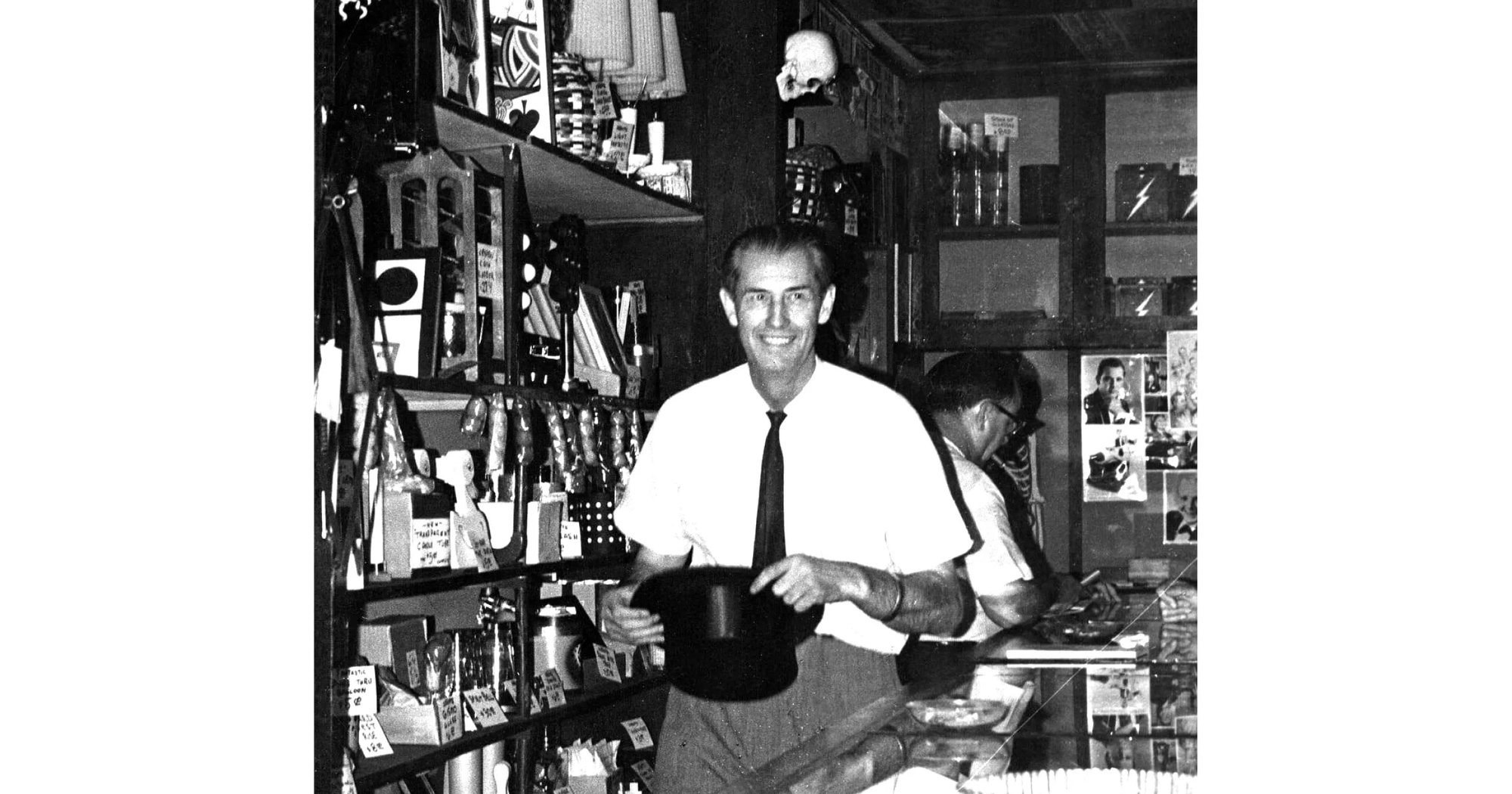
Finally, Paul Heller takes us to St. Albans, Vermont, to recall one of magic’s unsung heroes, the incredible Winston Freer. During his career in the mid-20th century, Freer forged his own path in the world of magic, and St. Albans played an important part in his work. Here is a look at his experiences, his challenges, and Freer’s remarkable levitation illusion that once made a tectonic rumble in the world of magic.
Many years ago, standing on the creaky floor at Abbott’s, I remember Recil Bordner telling me about Winston Freer’s tenure at the company. He described an incredible Freer invention that was being prepared for the Abbott catalog.
It consisted of a sort of magic table—a base with a single tubing upright—and a wide, flat glass bowl balanced on the center of the upright. The bowl was roughly the size of one of those old goldfish production bowls made by P&L. After showing the bowl in its precarious position, Freer stepped back and clapped his hands. The bowl disappeared. Instantly. Visibly. He returned to the single-post table, waving his hands to demonstrate that the bowl was really gone.
Freer’s secret, Bordner recalled, was a sort of curved strip of chromed wire (or maybe it was a flat, curved piece of spring steel) that was attached to a center shaft inside the upright post. A motor at the bottom of the table, concealed in the table base, spun this strip of shiny metal at a rapid rate. It supposedly looked exactly like a glass bowl; the spinning strip of metal described the circumference of the nonexistant punchbowl.
When Freer gave the signal, the spinning wire was rapidly withdrawn straight down, into the metal tube. That’s how the bowl disappeared.
Except, on that fateful day when Freer demonstrated it to Percy Abbott, the weld snapped where the wire was attached, and the spinning metal flew through the air, narrowly missing Abbott’s head. No sale.
I’ve often wondered how well this would have worked. I can completely understand the stress on that wire, turning the corner and being pulled into a metal tube. Indeed, this was the sort of ingenious, nearly impossible stuff being imagined by the legendary Winston Freer.
Far less perilous, we’ve got a month of great magic and magic insight for you; no actual flying pieces of metal. John Gaughan pauses to answer the Genii Questionnaire. Paul Wilson, Abby Segal, Blake Vogt, and Chris Kenner drop by to explain how tricks get put together.
Chris Power recalls when the penny dropped and he encountered the name of Jim Steranko. His column in this month’s issue also notes his friendship with the innovative Scottish magician Gordon Bruce. As the text was being assembled for the printer we received the sad news of Bruce’s passing on New Year’s Day. Our March issue will contain a suitable tribute to this well-known magician.
After 13 issues of the new Genii, I’ll now be stepping aside and turning over the job to your new executive editor, Will Houstoun. When Richard Kaufman called me and asked if I’d do the job for a year—to make the changes and to work with the new team being put in place—I knew it was an irresistible opportunity. As Voltaire said, “All sorts are good except the boring sorts.”
More than anything, I hope you’ve appreciated the hard work of the team that brings you Genii every month: Vanessa Armstrong, Chloe Olewitz, and Noah Levine—all incredibly talented, perceptive, and dedicated to the task. I’m grateful to Peggy Donmoyer, who runs the office and understands how all the pieces fit together. And, of course, thanks to Randy Pitchford for organizing and committing to this entire project and wanting it done with real innovation. Thanks to my boss Julie Eng, a past master of these subjects who has worked closely with us on every single issue to oversee the finished product and make sure that it set a new standard for magic.
These are the people who will be responsible for Genii along with your new editor, Will Houstoun. You’re in great hands.
I also thank our readers. That’s you. I’ve learned to be grateful to the magicians who subscribe to Genii, and the people who let us know what they think. That communication shouldn’t be underestimated.
Finally, a word from Will Houstoun:
As I write, it is mid-morning on January 1, New Year’s Day, and I am reflecting on the year just gone and the one to come. If you told me this time last year that I would be given the opportunity to join the Genii team I would have said it was a wish that was unlikely to come true. However, as former editor Richard Kaufman wrote in his email signature, “the Genii grants all wishes,” and now I am rapidly approaching the end of an induction period, with work already begun on our March issue, my first as executive editor.
As I have started to settle in, it has been a particular pleasure to hear your thoughts, as Genii readers and subscribers, about what you do and do not like about the magazine. It may not be possible to please all of the people all of the time, but it is important to me to get a sense of your thoughts, and I appreciate the time it takes to share them.
As Jim and I discussed last month you shouldn’t expect a sudden change in the magazine’s feel as I step in… that said, I and the rest of the team do have plans in progress that will shape the direction of Genii moving forward. For the moment we are dotting the i’s and crossing the t’s (as well as removing the extra u’s; how long do we keep using that joke?) on these, but I can’t wait to share more with you next month.
Don’t miss out on any magic news!
Subscribe to Genii magazine for as low as $69/year. Not only do you get all the latest and greatest magic news, but you also get access to our full digital archive that includes 89 years of Genii and 25 years of MAGIC Magazine. And, you also get full premium access to GeniiMagic.com content, and an annual visit to The Magic Castle.