
This month has been a quiet one in our inbox. We received a selection of private inquiries regarding Genii, which we were pleased to assist with, as well as some proposals for future articles for our pages that we are excited to share in due course. In terms of public letters to the editors, however, there were none. One of our regular correspondents did get in touch via Instagram. With his permission we share his note below.
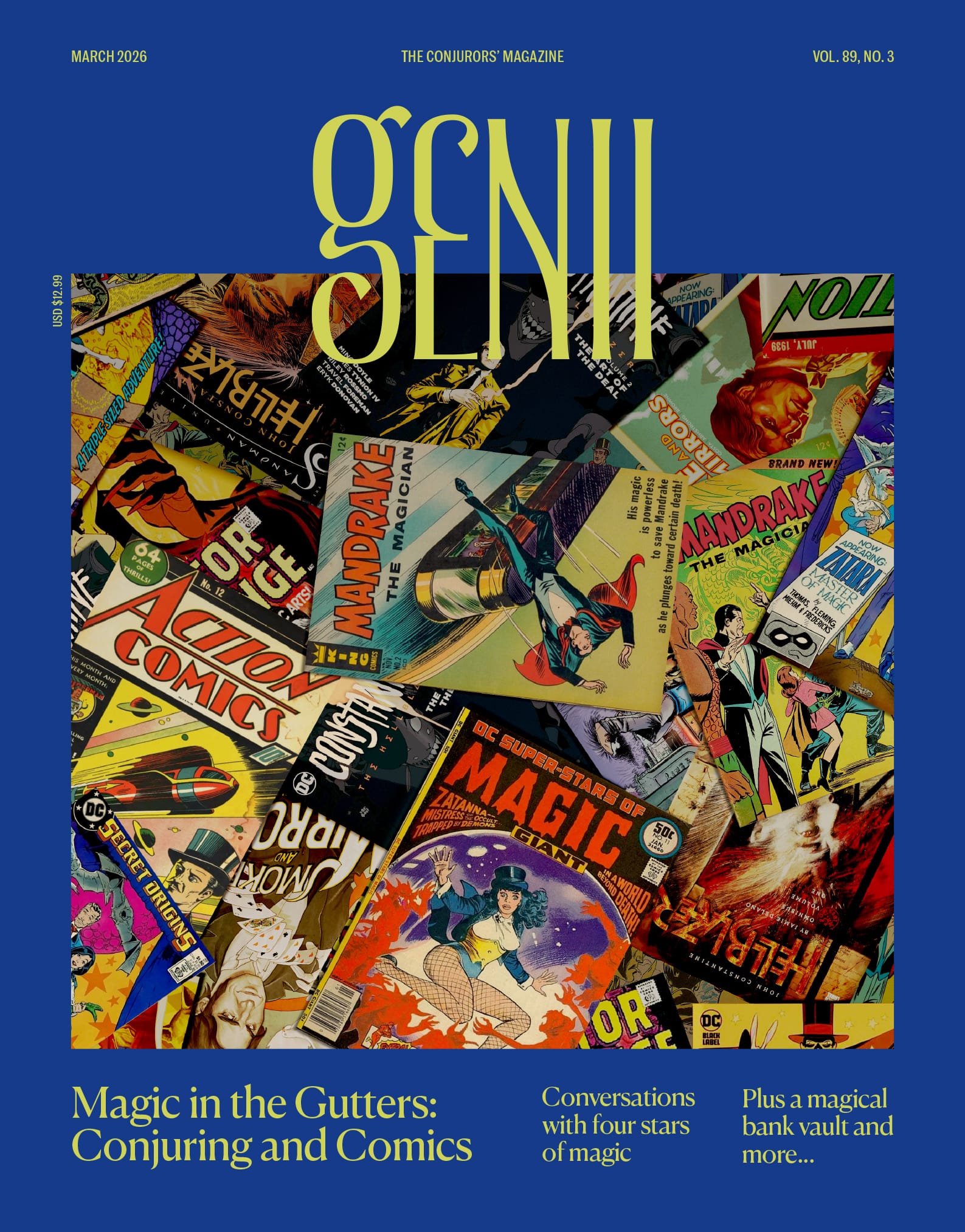
Magic in Comics
Since you liked Mike Costa’s observation about comics [in the March issue], you might enjoy Scott McCloud’s graphic novel Understanding Comics. His chapter on “the six steps” has become foundational to the way I think about art.
—Ethan Gordon
First, the recommendation is a good one, a book that I suspect other Genii readers may find interesting. As it happens, we already had a copy of McCloud’s work thanks to a portion of my partner’s PhD research that examined graphic novels. Having had a read I can endorse Ethan’s suggestion that the six steps can be a useful model for a variety of creative processes.
Second, the recommendation gets at one of the things I most benefit from when thinking about magic—the way that my practice as a magician overlaps with or differs from those of people working in other creative fields.
As well as being part of a magic club (The Magic Circle) and a union for performers (Equity), I am also a member of the Art Worker’s Guild. Founded in 1884, the Guild’s membership includes artists, craftspeople, architects, and academics, brought together not by commonality in the area on which they focus but by a commitment to an approach that values craft, creative connections, and the importance of the act of hands-on making. Practically that means that I never know who I will meet at the Guild, but I can guarantee that if I ask someone what they do the answer will be interesting—and often something someone says will open up a new way I can think about magic.
For example, while chatting with Fred Baier, a contemporary furniture artist, he observed that he can glance at a piece and tell if its maker works in metric or imperial measurements. That is because the systems work in base 10 or 12 respectively, and therefore facilitate different ratios between dimensions, giving pieces made in each a distinctive look. Prior to this conversation I had thought of measurement as an objective external process, rather than something that profoundly shapes the creative act. Realizing the impact those systems have in the creative process makes me wonder what structures and assumptions I am equally unaware of when I think about magic, and what new possibilities might appear if I examined them more deeply.
On another occasion, I was at a Guild event that was exploring and celebrating doubt and what it means to a selection of artists and craftspeople. One of them was Kay Gasei, a mixed media artist, illustrator, and designer, who talked about the different experience of doubt between creating work yourself as opposed to working to someone else’s brief. “There is nothing to doubt if your job is translation,” he said, referring to the process of translating a written brief into a piece. “Someone else has created the purpose and you try to realize it.” It strikes me that a lot of what we do as magicians is translation (or perhaps recital), rather than creation. An understanding of which category something I am working on falls into feels helpful in understanding both how I and my audiences relate to it.
One final moment of realization for me came during a talk from Walter Keeler, a studio potter who teaches as well as makes. When asked what technical skill a potter might ideally learn, he suggested the combination of “freedom of execution with precision.” Looking at sleight-of-hand and prop magic it seems this would also be the ideal combination. Since hearing the combination, every time I have noticed something “off” about someone’s handling it has been a deficiency in one or the other quality.
These are just a few of the possibilities I have peeked at after learning about other creative practices. Whether you find yourself swept into the world of comics, furniture, art, pottery, or any other practice, I think you will find there are endless new ways to explore magic that can be transplanted from other disciplines. And I think you will find them both enjoyable and productive.
The third and most important reason for sharing Ethan’s note, is that without it you would have had to endure an entire column from me, rather than something dressed as a response to our mailbox. I think we can all agree that nobody wants that to happen next month, so put pen to paper (or fingers to keyboard) and get in touch with your letters to the editors.
📬 Have something to tell us?
We encourage your comments, suggestions, and prohibitions. Reach us with the speed of email at editors@geniimagazine.com. We are, as the original genie insisted, here to serve.