
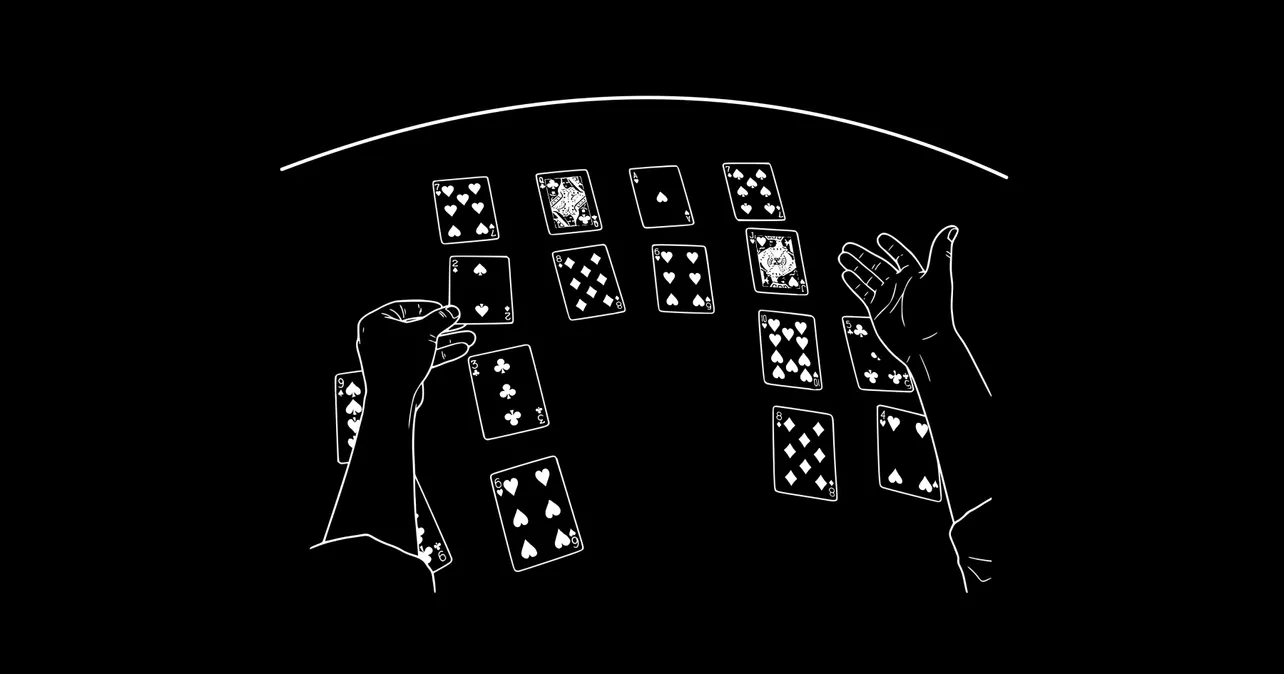
The Magic Square is often presented as a demonstration of rapid calculation. Typically a spectator names a number, and the performer quickly builds the square. Alex believes it’s more astonishing if the performer is not given the number before the square is built, but after. He posits that if the selected number is disclosed before the square is built, then the moment of wonder is diminished.
What makes this effect magic is that it is about discovering something mysterious hidden within the square all along.
Of course, for this approach to work you either have to force a number on the spectator or secretly learn a freely chosen one. Alex has done both over the years, and at times, even used a deck of cards to force the number. Using a deck of cards to force the number became the starting point for this routine.
The Sum is the result of exploring both presentations and methodologies for the magic square. It employs a sequence that uses both a force and information attained secretly from a spectator to engineer a revelation that does not resemble a magic square until the very end. This effect has an astonishing ending that no one sees coming. The Sum is the closer to Alex’s card act.
Effect
The magician introduces two decks of cards, one red and the other blue. The boxed blue deck is handed to a spectator for safekeeping.
The red deck is removed from its box and a spectator helps divide it into four packets. One card is removed from each packet. Each is seen only by the spectator and their values are silently added together. Their total remains the spectator’s secret.
Using those cards remaining from the red deck, the performer withdraws two small packets, which they use to determine the spectator’s secret value!
The blue deck is retrieved and taken from its box. It is spread face up, revealing four face-down cards placed throughout the spread. When those four cards are turned over, the sum of their values also matches the spectator’s total. And when combined with the spectator’s original four cards, they also add up to the total in multiple ways!
Finally, all the cards from both decks are arranged together—without changing their order—to form a four-by-four grid. It is then revealed that they form a magic square: every row, column, diagonal, the four corners, and even the center four cards add up to the exact same number—the one freely arrived at by the spectator.