
Spotlight: how do magicians handle mistakes?
This is a question our profession has spent endless energy anticipating. One possible answer to your non-magic friends, one that I think doesn’t violate “keeping our secrets,” is the mere conceptual idea of an “out”—shift to using a different method to reach a sufficiently mysterious conclusion, even if it is not the one you planned. This, too, of course, takes confidence, skill, and practice.
Your muggle friends can also appreciate that you have extra flexibility if your audience does not know in advance the outcome you intended. In my book, Secrets Magicians Could Tell, The Art of Presenting... You!, I encourage non-magicians to take a lesson from us when they are making any presentation, from a business talk to a wedding toast. If you forget a point, that might matter if you are teaching neurosurgery. Most of us aren’t. Listeners don’t know what you were about to say, so instead of muttering, “I forgot something,” and backing up, most times the point can be covered later (out of sequence) without dire consequences, or not at all. The audience is none the wiser. I’ll have a little more to say about “mistakes” in a few moments.
Limelight
If you never had the pleasure of watching Sid Lorraine’s hilarious comedy, or enjoying his enormously engaging and kind offstage disposition, you can still experience it by reading one of his many humorous writings, like Patter (1938) and More Patter (1950), as well as his books of tricks and routines. Much of that content works as well today as it ever did. His column, “Sid Lorraine’s Chatter,” featured in Tops and The New Tops for decades, and he frequented all the conventions as a performer and as a gracious friend.
Sid was also a talented artist, illustrating magic texts and creating line art for customers of Abbott’s Magic Company. My own magic business cards (from 1966 until today) employ a Lorraine drawing of a relaxed magician floating horizontally over the name and contact information. It always gets good reactions. Sid’s illustrated, personal holiday cards are mementos treasured by his friends and now by collectors, too. And Sid was topical in the moment; who else might have used sponge technology to create the 1970s close-up trick, Moon Rock?
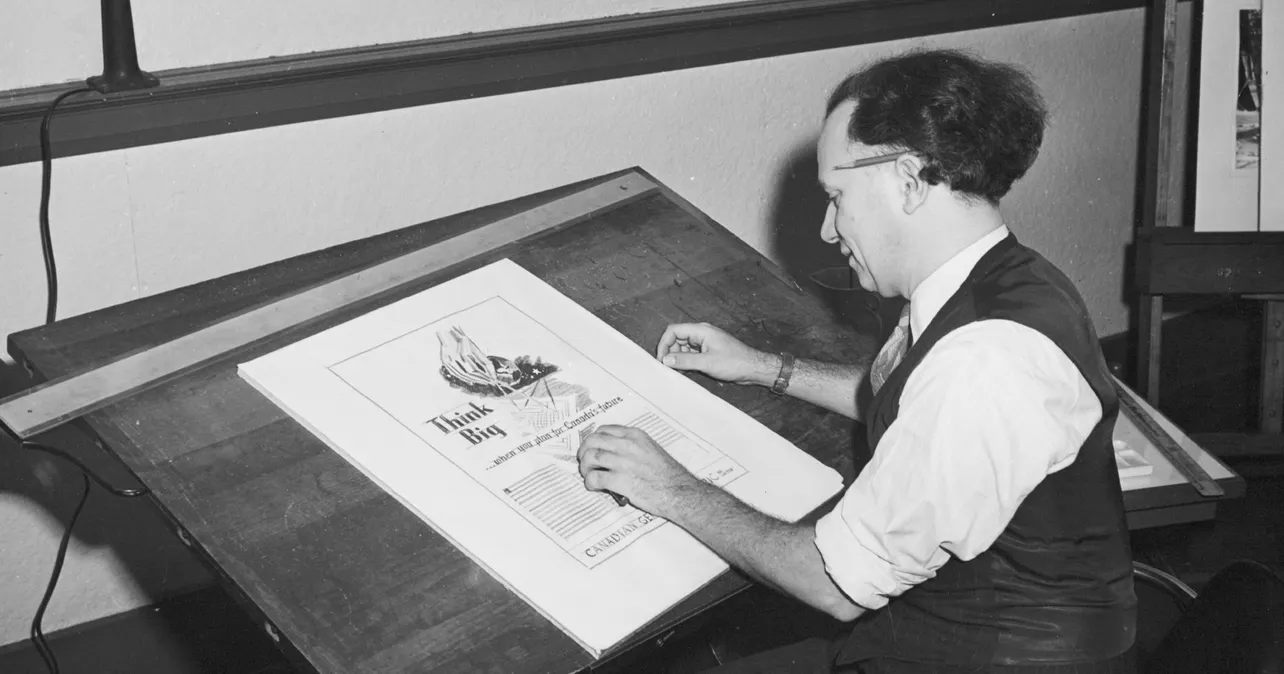
As always, Sid enters our “limelight” because magic was central to his soul, but not to his career. Sid’s fellow Canadian, David Ben, has guided me on the specifics. At age 15, in the early 1920s, Sid joined the art department of the Toronto advertising design, merchandising, and printing firm originally named Grip (later Rapid Grip and then part of Batten & Co.). After a merger with Barton, Durstine & Osborn, it became what is still known as BBDO, now a world leader in its field. Courtesy of David, we can see a young Sid (Johnson, his real name) at work in this column’s illustration.
Prompt box
This month, I reluctantly illustrate my point with a story told about me. While I write about magic history and disclaim being a practicing magician, my lengthy practice long ago makes me able to do some pretty capable magic. I draw on those same muscle skills that let me still ride a bicycle, I suppose.
Recently, though, I was asked to show one “simple” trick in a talk that otherwise had nothing to do with magic. Instead of picking from my core repertoire, I reached for a prop at hand to demonstrate the magic milk pitcher. My good friend, the late Frances Marshall, said once in a column in Abracadabra: “Anybody can buy a Vanishing Milk Pitcher, read the directions, and do it.”
Well, I didn’t read the directions. I knew how to do it, and had done it a million times as a teen. So on this night, in front of a thankfully relaxed audience of non-magic colleagues, I mentioned my lifelong interest in magic. I brought out a pitcher, with bright red liquid (much better to see). With elegant flair, I made a newspaper cone (which, as you know, is harder than it looks). Cheerfully engrossed in the presentation and convinced of the wonder of it all, I poured the liquid into the cone—all of the liquid. “Hmmm,” I then thought, “this is not good.” It took a moment, but soon of course red liquid was enthusiastically pouring out of the bottom of the cone. I leave to your own creativity what might have been your “out.”
Deus ex machina
That embarrassing story brings us back to our starting question: “How do magicians handle mistakes?” One, private answer is that we silently curse ourselves (or others) when mistakes occur. Taken more broadly, this is a question that I have raised in panel discussions at magic history conferences over the past few years and I think about it a lot.
In our performances, of course we want the magic to work. In my academic (and my magic history) writing, too, I want to be engaging and also accurate; precise with facts, precise with sources, free of typographical errors. These hopes keep us on our game. Yet, despite it all, we are human (I hate being human, at least for this purpose). Errors happen.
We want the magic to be perfect, well planned, and well practiced. Magic literature, however, is full of advice that you need to get better by frequent repetition, performing again and again for real audiences. And I spend time encouraging friends in the magic history community to tell stories, whether researched essays or personal anecdotes, even if they do not have regular (much less academic) experience in writing for an audience. The pages of Genii over 90 years are filled with examples of the delight of new voices and old tales. Perhaps the standards we set for ourselves, and equally for others in the magic community, pose a philosophical conflict and a silent barrier to this encouragement and inclusion? Should an insistence on perfection not stop us from showing up? Don’t we then need to embrace mistakes (our own, and those of our peers)?
I conclude that along with our aspirations to be the best we can should come a healthy, generous dose of forgiveness. Forgiveness when that chosen card can’t be found again in the deck, or when there is a typo in that footnote citation. I am starting by working on forgiving myself... it takes practice. Join me.
With that, I conclude our two-year conversation together in the pages of Genii. It has been my privilege. Now, just like Houdini’s elephant (well, almost), I will disappear!