
Blake Vogt Welcome to Inventing Magic, Episode 12. This month’s special guest is the one and only Chris Kenner. Holy shit. You are one of, if not the best person in the world to jam with. So this is a dream come true!
Chris Kenner Thanks. I heard you talk recently about something I used to do. I used to write down an idea a day, every day, no matter what. I don’t do it anymore, but every single, real creative thing that I’ve done for myself came from this process. And at the time I was just doing magic for a living, and I really wanted it to be not just a card trick or coin trick.
At the time, I was trying to do stand-up comedy and some comedy magic. So I got into weird objects and things. I would have [for example] a bunch of different ideas for Nest of Boxes, and because that can be anything, I’d break it down into the formula, and then the formula makes it easier to come up with the thought. So with the Nest of Boxes, I had come out with a shoe you forgot to pack, and you have somebody sign it. And then you vanish in your favorite method. It would appear in a suitcase that was in another suitcase, that was in another suitcase that ended up in the shoe bag and in the suitcase.
From this same process, I wanted to borrow something from a person that they were going to throw away. A piece of trash. “What do you have in your handbag that’s a piece of trash? Anything. It could be a lipstick container that you used, a chapstick, a bottle cap.” They give that to me, and I would vanish it. And I say, “Where would it naturally go? In a trash can.” So then the table that I had was basically a cloth [covering a form]. I would pull it off, and it was a metal trash can, and then in that was a kitchen trash can, and in that was a small trash can, and I’d step on the foot pedal, and this bag would pop out with the thing tied, catch it and undo it, and the object was in it.
When I started thinking of rapid-fire ideas, and didn’t have methods, I hate to say it like this, but I’d just fake it once. Give a person a ring, or borrow something from them. You’ve got a duplicate of it in the trash. No worries about any method, totally presentation. I’ve done a few of those, and they fell flat. So it wasn’t worth the trouble.
BV I did that a few years ago. I had a dumb idea for a trick, and I couldn’t figure out a method, but I didn’t want to waste time on it, so I stooged the whole thing. I had to pick two people. It was at a college in South Carolina, and Jonathan Bayme happened to live nearby. I didn’t know he was coming. I stooged it with two people. I just said, “Hey, can you just say this for me?” and, “Can you just hand me this thing?”
And I just wanted to see if it would work, and it fooled Jonathan so badly. I don’t know to this day if I’ve ever told him that it was fully stooged but that’s how I knew it’s worth trying to figure out a real way to do this.
CK That’s part of the creative process: Knowing when you really have a hit.
I did this thing called the Texas trick, and it was the formula of the Nielsen bottle, where you take the bottle, put it in the bag and say, “I’m going to make it disappear.” Snap and say, “It’s gone. Oh no? Really!” And you turn the bag upside down, obviously holding the bottle, turn it back and say, “Oh no! It’s back.” [And then you vanish the bottle by crumpling the bag.]
I didn’t have an opening, so I just did that for the first week, until I came up with something. And then I came up with this Texas trick, which is basically the same formula, although it doesn’t look like it.
The formula doesn’t have to be exact. Use a formula like a borrowed object to impossible location. That is different from your object signed to an impossible location. That’s different from your object to known location.
A known location would be like, “I’m going to make this appear in the card box.” It’s still an impossible place, but you’re letting them know. It’s on my keys from my back pocket. That’s an impossible location. So you kind of look at exactly what the trick you think works? If there’s a trick you do that works, and you know the beats work and the jokes work, you can just replace the beats with what you need.
BV That’s so smart. The inverse of it too. I have quoted you many times saying that if I ever get stuck, I take a trick I hate and figure out why I hate it.
CK One of my favorite lectures I ever saw was a 20-minute thing by Guy Hollingworth where he came out, and he showed this gimmicked Kings trick that he loved. And he shows it to the audience and everybody. It’s great. And then he says, “Then I decided it had too many gimmicked cards in it, so I wanted to do it with no gimmicks.” He goes through and he shows this method that he came up with, without gimmicks. And then he said, “You know, it was good, but it missed this point.” So he put one gimmick back into it, like a double-facer, whatever it was. And then at the end, he said, “What I realized, in doing this, is that the trick was better before.”
BV Do you ever do cards onstage?
CK Yes. I did a version of Blackstone’s Favorite. You have somebody pick a card and put it back. [And shuffle.] I have them give me a number for 10 to 20. It doesn’t matter what they say, could be 12, and I’d say, “Oh, great, I have sensitive fingertips. I’m going to reach down and cut 12 cards off the top of the deck. The next card will be your card.” It’s a Harry Lorayne thing. It’s been around forever. What do you want to solve?
BV Here’s a jumping-off point. This might seem like a silly question that I’m asking you, but I’m genuinely interested. I know all day, every day, with David and Homer, you guys are jamming. But what do you find yourself fiddling with outside of that environment?
For example, Ambitious Card is a great trick that everybody does. I think it’s so overdone in a way. Daryl’s thing is the best, if you just did that. Everybody signs it, rope around it, put in the middle, comes to the top once, that’s it. That’s great. I’ve always wanted to have a card signed by everybody, place it in the center of the table, put the deck on top of it, and then cover it with a glass, have everyone, someone else, do the whole thing. And then at the end, you lift it up and the card is on the top.
It would be a crazy trick to do with eight people, and seven of them are in on it.
CK I’ll show you another trick that’s a problem that I want to [solve]. When I was a kid, they made these little metal safes—safes with a little dial on it, and you could open it. You had a combination. It’s a cheap looking thing, with a slot at the top to put coins in. To me, Coins Across is a great trick. But if you break it down into exactly what it is, what is the perfect version of a coin going from one place to another?
I took the little safe, and inside of the safe, I had a little thing in there to hold one coin, a little like velvet [pad] that I could just stick a coin in, and you’d see it when you close the door. So you take one coin, you say, I’m going to do a trick with a single coin. You pass it around with a marker. People sign it. Everybody signs it so it’s signed on both sides. Bunch of people. No possible way you have a second one. Someone else puts it inside of the safe, closes the door. You never go on that side of the table. You’re on the other side of the table. I would love to flick the lights out and turn them on and I’m just standing in the same spot, holding the coin. That’s it. Coin Across.
It’s such a simple thing at the same time it’s complicated. I was going to have Larry Odine make a little box, such that once I put the coin in, it would go under the table, and a conveyor belt would bring it over. The coin would be a magnetic silver dollar. It’d come over on the conveyor belt and land on the other edge of the table, and my leg, which would have a magnet on it, would just have to brush up to it. Now I can walk away, pick the coin up and produce it. So that’s the effort that I wanted to go and it was going to cost me $10-15,000 to do a close-up trick I’d do twice.
BV For the average Genii magazine reader…
CK Well here, this is a big thing that I’d love for somebody to do. You have a person come onstage and you have a gigantic plexiglass box and inside of it is a plexiglass table and two small plexiglass seats. Everything’s clear. Every single thing is clear. The only thing inside of there is a deck of cards and a marker. You and the spectator walk in, you close the door. There’s no way to get in or out. The person signs the card, puts it in the deck, shuffles it. They pick a side. (Though you could do whatever if your method revolves around just one side working.) You spring the deck to one side. One card sticks, but it’s on the outside. It’s a Card to Window. But an impossible version.
BV This is a running theme with stuff you’re talking about, which is so cool. This concept you brought up at the beginning of just taking a formula, a trick, or a premise, and asking what is the ultimate end all be all version of that thing, right?
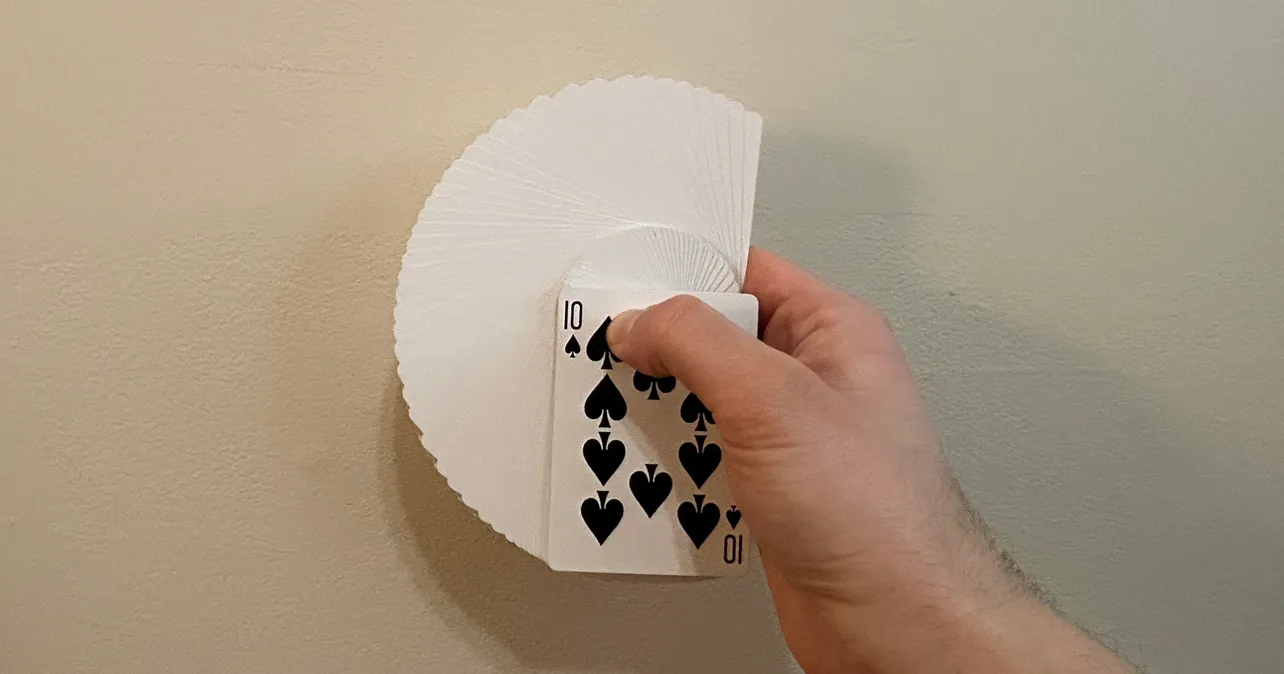
BV We have eight minutes left, here’s the challenge. What is a fake trick? One of the coolest things I heard you just say, that I kind of want to try, is the next time I’m with a group of friends, is to just say to one of them, “Name the Ten of Spades.”
CK So with that said, when I was a kid, there was a guy named Harold D. Russell. Very funny guy, comedy magician and he was infamous for a trick with a quarter. And the trick was that he never, ever told anybody how it worked. OK, that’s the story. There was never, ever, one, same human being in the room. I think he had multiple methods, like multiple, multiple things.
There were always three different cups, and you would put it inside of one. He would turn around, and he would tell you what cup it was in. And essentially, I think for the most part, it was just somebody telling him. But, you know, I saw him do this a time or two on the spot, where I knew his buddies weren’t there. I wasn’t telling him. I think he had more than one method. With that said, you can really mess with somebody if you have that in a magic trick.
BV I love this, because this is quick and just theoretical. The method is someone is in on it.
CK Let’s say you do a simple Chop Cup once. I want a remote-controlled Chop Cup. I want a Chop Cup with a remote on it. You should show a ball, show a cup. Put the cup on someone’s hand. They put their hand on top. Have another person and another person. There’s a bunch of people with their hands on it. Nothing in the cup. “Let’s lift it up with all your hands on it. OK, put it back. And then remember that ball I had that I put in my pocket? It’s going to vanish.”
You don’t even have to show it again. Leave it in your pocket. “It’s going to vanish and appear in the cup, and you’re going to feel it in 1-2-3,” and they’re going to react. You could fake that trick.
BV That makes me think of the coin vanish, where you cover it, and everybody reaches under to feel and make sure it’s there, and the last person takes it. That’s a fooler. With the cup thing you were talking about, all you would need is a cup that has a false bottom and then whoever the first person is that puts their hand on the cup is just pushing the ball down and in.
So there you go. That way the person who’s hand it is actually does experience it, because another person’s hand is holding it above it, and all of the other hands are real.
I feel like this needs to be an article of just quotes you said, and then like a little paragraph about how to get your buddy to help you with the trick.
CK And there’s nothing wrong with that. And this is the thing. If if you do a thing like that, you should really take it to the fucking grave, because I don’t know how Harold did that trick. And it was the simplest, dumbest little trick.