
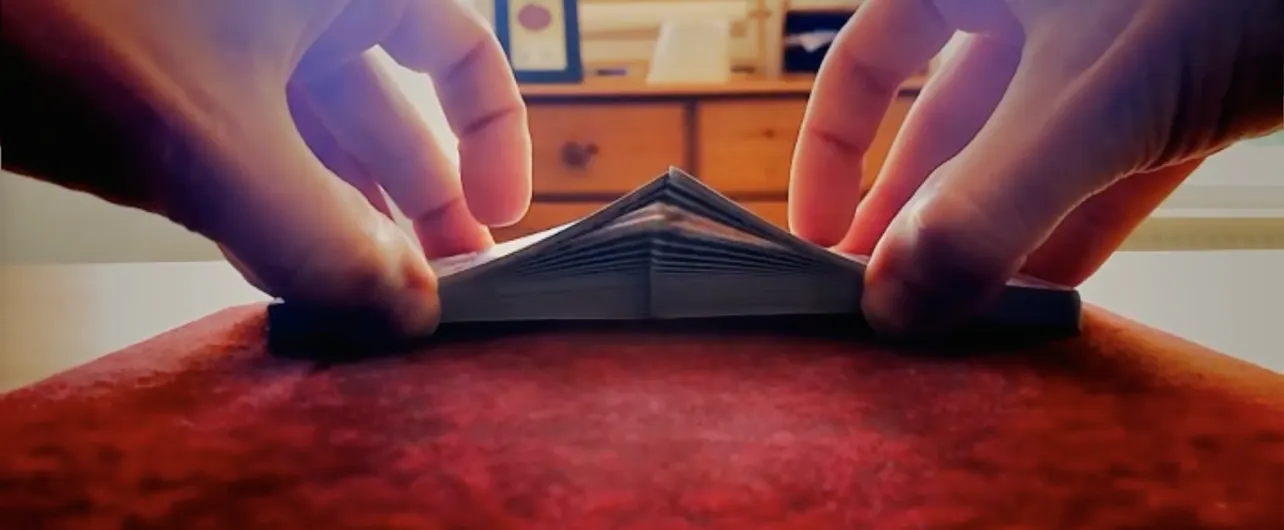
You likely know that it takes seven riffle shuffles to thoroughly mix up a deck of cards. Mathematicians Dave Bayer and Persi Diaconis came up with that proof in 1992, and it works as long as a deck of any size is divided into two roughly equal piles.
Do you know, however, how many shuffles it takes to thoroughly mix the deck if you don’t divide the deck into two even piles? No one did, until Mark Sellke and his colleagues Jialu Shi and Jiamin Wang worked to figure that out.
“It’s a fresh idea, and it’s remarkable that something like that would work as effectively as it does,” Diaconis told Quanta Magazine about the three’s findings. “It’s a brilliant piece of mathematics.”
Sellke, Shi, and Wang worked by giving each card in a deck a “0” or a “1” depending on which pile it ended up in after shuffling and dividing. I recommend heading to the Quanta Magazine article to get the details, but essentially if identical patterns of zeros and ones lined up from each pile, it indicates that the deck isn’t fully mixed.
 John Pavlus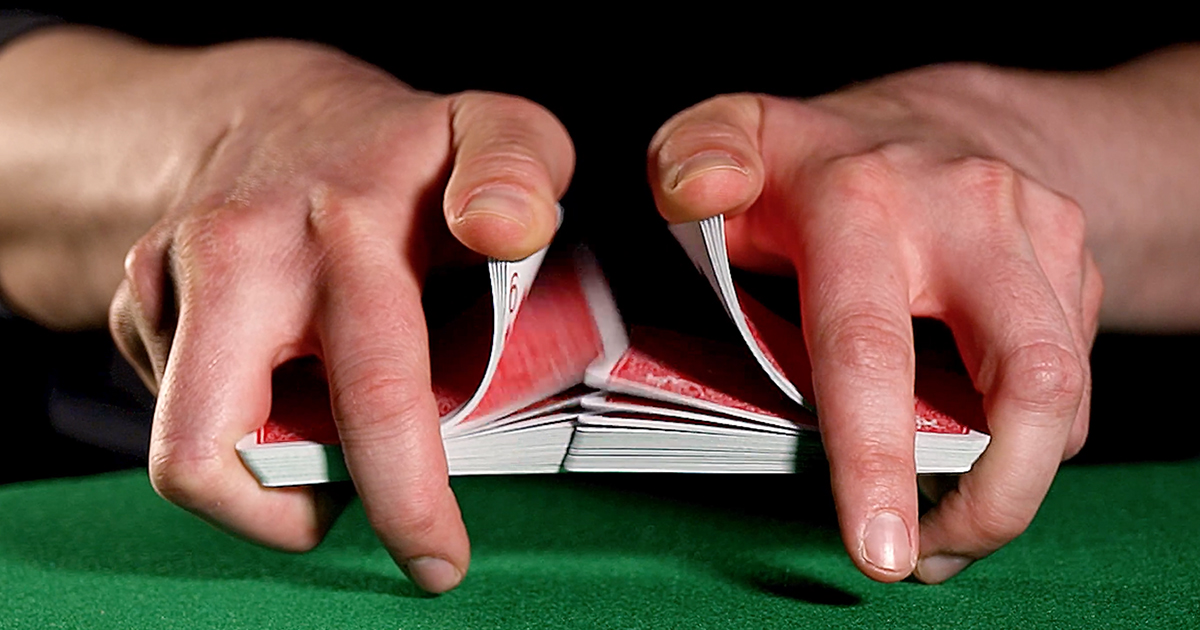
The three ultimately showed that the cards became fully mixed at an exponential rate, and the exact number where they became fully mixed depended on the number of cards used. If you used 52 cards, to just pull an example out of the air, it would take 14 shuffles to fully mix them if you didn’t evenly divide the deck into two piles each time.
This proof still requires that the piles be riffled together perfectly (as in a Faro Shuffle). Sellke told Quanta, however, that his next goal is to tackle a clumpy shuffle. “I haven’t made progress for a while,” he said about the clumpy scenario, where cards aren’t shuffled one on top of the other. “Maybe after someone makes a bit of headway, then we can try again to adopt the understanding we’ve already produced.”