
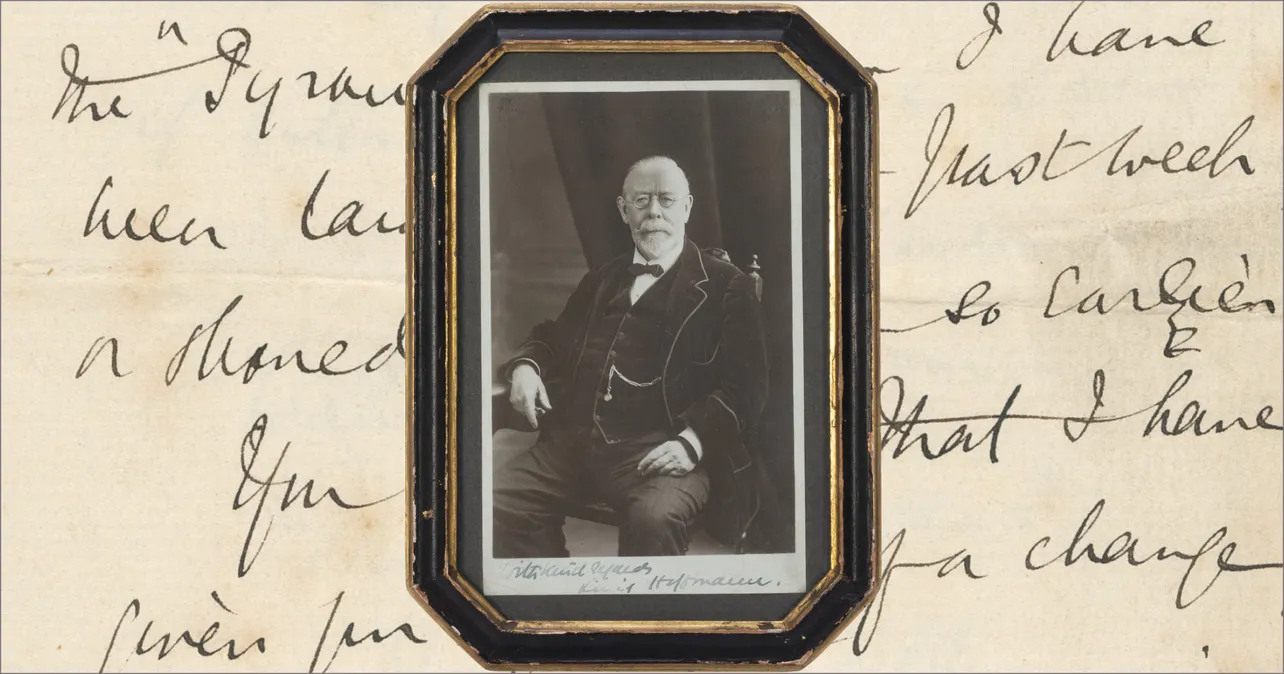
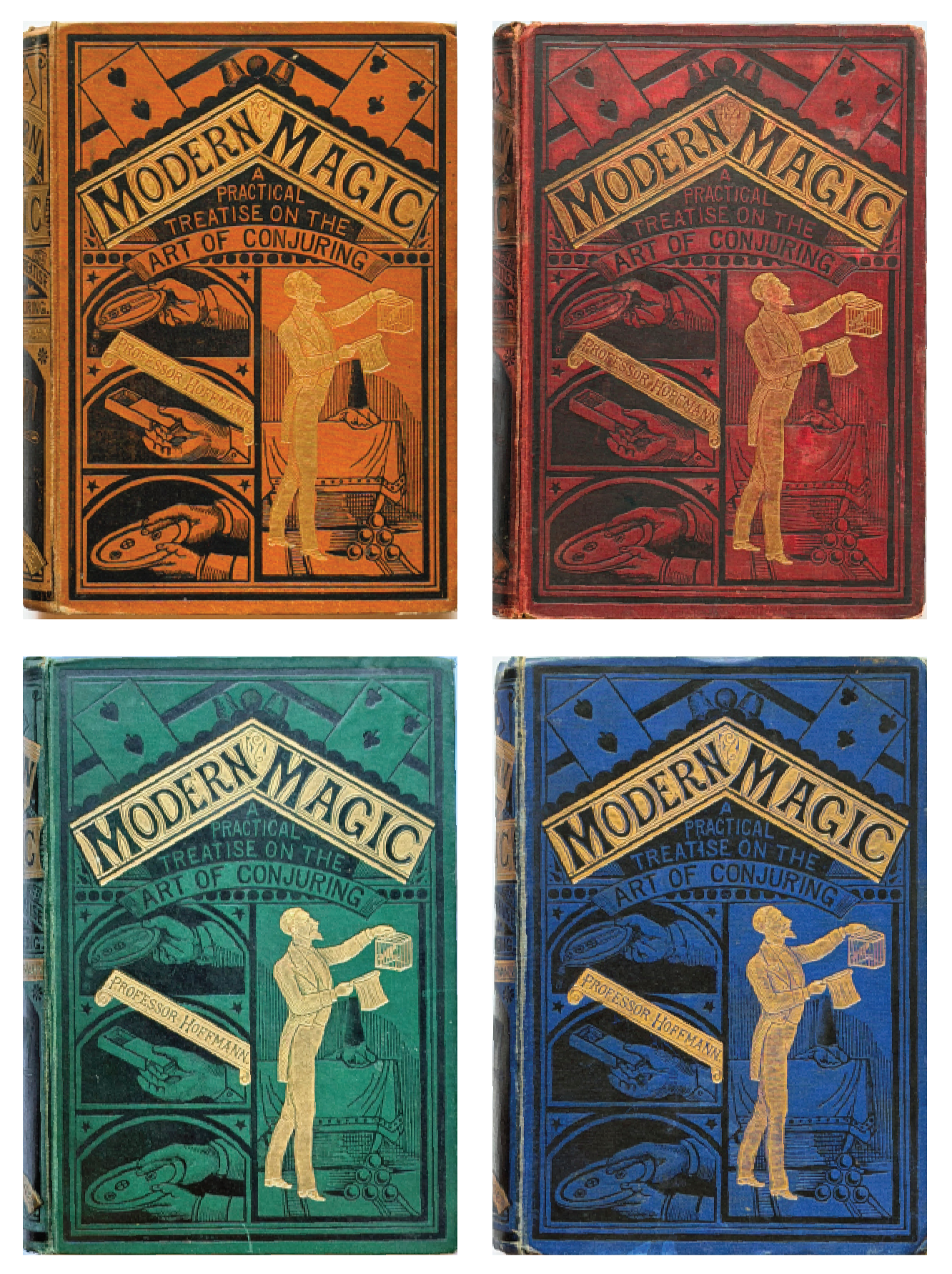
This year marks the 150th anniversary of the publication of Modern Magic by Professor Hoffmann. To say that this book is important to me would be an understatement—it was one of the first magic books I read, was the subject of my doctoral thesis, and informs almost every aspect of my current practice as a magician. The influence of Modern Magic, however, is not just some personal quirk. Hoffmann’s book has also profoundly shaped your experience of magic—at this point you just might not know how.
During the Victorian period, the British public had increasing leisure time thanks to the benefits of the Industrial Revolution, and as a result there was greater interest in recreational pursuits. Simultaneously, magic was undergoing a popular rebranding, framed arosund the gentleman conjurer as the kind of respectable entertainment that a modern audience might enjoy, as opposed to the superstitious nonsense Victorian writers (perhaps erroneously) claimed it had previously been. More than just entertainment, magic was being presented as something rational and scientific, of real benefit to society.
Conjurers took to print to denounce and expose card cheats, positioning themselves as protectors of the honest public—for example Robert-Houdin’s Card-Sharping Exposed (1882) or Maskelyne’s Sharps and Flats (1894). Magicians also helped support the British Empire, perpetuating the racist notion of Western superiority over other cultures—see Robert-Houdin’s purported domination of local tribes in Algeria, Colonel Stodare’s Sphinx illusion, and Maskelyne’s Psycho or Zoë semi-automata, which all stage Western control and superiority. Interaction with the ideas of thought reading and spiritualism even engaged magicians with the biggest philosophical challenge of the day: the reconciliation of a modern scientific way of life with a fundamentally religious worldview.
This rich cultural milieu sets the scene into which the protagonist of our story emerges.
While You Are About It, Be a Professor

Angelo John Lewis was born in St. Pancras, London, on July 23, 1839. He had a youthful enthusiasm for magic, which evaporated by 1895 when he left home to study at Wadham College, Oxford. At university he studied for a general bachelor’s degree before returning to London to sit the bar examination, which he passed in 1861, becoming a barrister-at-law.
During the 1860s, Lewis’ private life shifted gears with his 1864 marriage to Mary Ann Avery and the birth of their two children, Leonard and Maude. Crucially, for our tale, he also had a number of short stories published, as well as working for the popular magazine The Saturday Review. He also happened to see a performance in Crystal Palace by Professor Anderson, the slef-styled “Wizard of the North.” Lewis thought that Anderson’s show was both cluttered and dated, but nonetheless it led him to track down a number of French magic books (Almanach Manuel du Magicien des Salons (1862); La Sorcellerie Ancienne et Moderne Expliquée (1858); and Robert-Houdin’s books) which rekindled his interest in conjuring. As the 1860s turned into the 1870s, Lewis was well educated, knowledgeable about magic, and connected within the literary world. Just one more thing needed to happen for Professor Hoffmann to wink into existence.
Early in 1872, Lewis arranged to meet Edmund Routledge, a partner in the Routledge publishing house and the editor of The Young Gentleman’s Magazine since its inception in 1862. Lewis had heard that Routledge was planning future volumes of the magazine and thought that he might be able to contribute a few articles on conjuring, combining his literary and magical interests. At their meeting, Routledge was impressed by Lewis’ knowledge and asked: “Can’t you make a bigger thing of it, and give us copy enough to bring out as a book after we have run it through the magazine?” Lewis agreed, and the resultant series ran over 48 issues between 1873 and 1876 before being collected and bound as a book.
Lewis’ one concern was that his serious legal colleagues might think less of him if they knew that he was the author of a book about magic tricks. Equally, Routledge worried that not listing an author would compromise their sales. In the end they agreed that Lewis would write under a pen name, with his real identity kept secret. “I hit upon ‘Hoffmann’ as a name of uncertain nationality,” Lewis said, “and left the public to imagine, if they chose, that some distinguished German or American wizard was giving away the secrets of his craft.” Looking to boost his author’s status, Routledge then suggested: “While you are about it, be a Professor.”
So Professor Hoffmann was invented, both as a marketing tool and as a cover story, to allow Lewis, a multilingual, magic-enthusiast barrister, to combine his interests and sell his services as an author of magic books. That particular set of skills and qualifications allowed him to write a work that shaped the very foundations of the world of magic.
A Modern Magic Book

Modern Magic is beautiful, bound in cloth and decoratively stamped with black-and-gold illustrations of magical apparatus and a magician mid-performance. The text is spread over 500 pages and lavishly illustrated with diagrams that tantalizingly hint at the secrets contained within. The book describes almost all facets of magic, from the simplest card trick to elaborate stage illusions. Some require only a few hours of rehearsal while the more complex would need thousands of hours of practice to perfect. The oldest effects in the book had been described hundreds of years earlier, while others were at the cutting edge of Victorian conjuring.
The defining feature of the book, however, was neither its appearance nor the repertoire it covered—it was the approach it took to teaching magic. Lewis comments in the introduction that there “is a vast difference between telling how a trick is done and teaching how to do it. The existing treatises,” he then explains, “with few exceptions, do the former only. The intention of the present work is to do the latter also; to teach sleight of hand generally, as well as particular tricks.”
David Devant highlighted this innovation, suggesting that “to appreciate it [Modern Magic] to the full I would ask you to turn to any of the earlier works on conjuring and try to learn one trick from any of them. Then turn to any page in Modern Magic and if you cannot then see what Professor Hoffmann did for conjuring—well, I am sorry for you, because you cannot be mentally sound.” An example might be comparing Lewis’ description of The Nerve Trick with that in a contemporary book.
Every Boy’s Book (1863) was published just over a decade before Modern Magic, and targeted a similar audience. Picking up the explanation part way through its description of the trick, after the chosen card has been controlled to the top of the pack, it instructs: “...desire him to hold it between his finger and thumb just at the corner; bid him pinch them as tight has he can; then strike them sharply, and they will all fall to the ground, except the bottom one, which is the card chosen.” This description is imprecise, giving no suggestion of the orientation of the spectator’s hand, little detail on the positioning of the fingers on the pack, no information as to what direction the pack should be struck in, and no theory as to why the trick should work.
Starting at the same point, compare the description in Modern Magic. “Give the pack to some person to hold. The cards should be face upwards, so that the chosen card will be undermost, with the thumb of the holder above and the fingers below the pack. The fingers should extend under the pack for about an inch, but the thumb above not more than half an inch. Request the person to nip the cards tightly, and as he does so give them a smart downward rap with your forefinger, which will knock all the cards out of his hand with the exception of the lowest card, which will be retained by the greater friction of the fingers, and will remain staring him in the face.”
In contrast to the explanation from Every Boy’s Book, Lewis gives precise information on the orientation of both the cards and the spectator’s hand, how the pack should be held, how the reader should strike the pack, and an explanation of the underlying principle behind the effect.
The card magic section of Modern Magic also showcases Lewis’ broader approach to teaching magic. Spread across four chapters, the progression for the reader is clear and specific. Lewis begins by explaining a selection of utility moves like passes, palms, and changes. These are challenging techniques, but they form the backbone of classical card magic and are an important component of a well-rounded magical education.
Having asked his readers to invest time and effort in his first chapter of card magic, Lewis then rewards them with a selection of self-working card tricks. This lets them start developing performance skills, without the challenge of complicated technique. In the third chapter, Lewis reintroduces the secret moves from the first chapter and challenges the reader with material that involves covert manipulation or special cards. Their skill level is constantly stretched, as the magic they learn becomes increasingly impressive.
Before moving away from cards, Lewis introduces his readers to elaborate special pieces of card-magic apparatus. For some students, these will form an introduction to the world of stage conjuring, and for others, while the information will not be of practical use, they will at least have a thorough general understanding of all branches of this aspect of the art.

This clear and logical structure seems like the obvious way to write on the subject today, but typically books of the time were constructed less sensibly. The Secret Out (c. 1870), published around the same time as Modern Magic, is a perfect example. The first item in this book is an easy card trick, requiring no sleight of hand, and the second is a difficult effect in which a chosen card appears inside an egg. In just two tricks, the author jumps from self-working magic to a piece requiring special apparatus and sleight of hand. The description of the Card to Egg also includes a reference to forcing, a technique that is explained 40 pages later in the book, and a prop that is described, under a different title, halfway through the book. For his third trick, the author returns to the easy style of magic he started with.
The lack of structure in The Secret Out, and similar books, makes them difficult to learn from and confusing to read. In direct contrast, Modern Magic leads the reader progressively through stages of increasing complexity, guiding them to become a capable performer with a solid knowledge of conjuring, two of Lewis’ major goals with the work.
Lewis’ final innovation was to frame his magical instruction as something that offered broader benefit to his readers. He believed that young people should learn magic, not because they were going to become magicians, but because it could teach them skills that would be useful in other areas of their lives, such as their professional careers. For example, it would teach them to spot deception and deceit, present information to a group, and solve problems.
These broader educational aspects of Modern Magic were, somewhat bizarrely, most explicitly set forth by Julian Simashko, the translator of the Russian edition (1877). Simashko suggests that magic can help with the “development of powers of observation, inquisitiveness, and ingenuity,” before addressing a skeptical reader: “Just try doing one or two tricks, you will have to do a little work: There is need of understanding the secret of the trick, arranging your facilities according to your goal and, on top of that, being at some work upon your hand in order to impart it with dexterity and flexibility. We saw that children successfully overcome these difficulties, figure them out with love, arrange the material according to the goal, in a word—they contemplate.”
This approach to magic, along with Lewis’ structured and precise instruction, created a book that was uniquely positioned to capture the public’s attention, as well as that of magicians.
Hoffmann Deserves to Be Hanged

Modern Magic was well reviewed, even before its initial serialization had come to an end. “The most attractive feature of this volume will [...] be found in the ten articles by Professor Hoffmann on ‘Modern Magic,’” observed The Graphic, before drawing attention to the quality of the tuition, with “the instructions as to the tricks being more than usually lucid.”
When the book was published, reviews were equally flattering. The Examiner said: “Professor Hoffmann’s book is recommended to those who wish to study the art of conjuring, because it is by far the best in the English Language,” while The London Daily News commented, “Professor Hoffmann’s thick volume on Modern Magic (Routledge and Sons) seems to be almost a cyclopedia of marvellous tricks.” Perhaps the most glowing review came from Tatler. After explaining that magic books are normally disappointing, it proclaimed: “The perusal of a very few pages convinces the reader of two things. The first is that Professor Hoffmann possesses a vast knowledge of conjuring matters; and the second, that he has all the literary ability so necessary to describe the proper working of tricks.”
The book was a success, with the first edition selling out in fewer than seven weeks. Sales continued to be strong, as the book went through numerous editions—over the next 40 years, the publisher sold nearly 16,000 copies, alongside 45,000 booklets that reproduced sections of the work. There were also numerous American editions, as well as five Swedish editions and the aforementioned Russian one. Other books also plagiarized part, or even the whole, of Lewis’ text—a copy of The Art of Modern Conjuring “by” Henri Garenne exists in which Lewis wrote: “This book is a rank piracy and was suppressed accordingly.”
The complete, lucid explanations of a wide range of contemporary magic tricks—which led to the success of Modern Magic—made the book rather unpopular with some magicians. Long before TikTok exposure, online tutorials, or instructional magic DVDs and VHS tapes, Lewis’ book was seen by some as heralding the end of magic.
Stanley Collins, writing to a friend, rhetorically asked: “What do you suppose would be the reaction of the world’s conjurers [...] to the presumptuous and unscrupulous Stanley Collins, who, regardless of the interests of professional conjurers, arrogantly exposed every novelty of the hour?” The result, he suggested, was that “his mutilated remains would be discovered in some noisome ditch with a dagger stabbed into his torso transfixing a card to read: ‘Gone to the warmer climate whence go all exposers of conjuring.’” Others commented, “the golden days of magic are over; the world will be as full of magicians as the Jersey coast is of mosquitos,” and, “Hoffmann [Lewis] deserves to be hanged.”
Frederick Eugene Powell, then the Dean of the SAM, made the most extreme comment: “I have always thought that it would have been well had he died in his Mothers [sic] womb,” he said. “He started this awful avalaunch [sic] of BOOKS. I wish every one was taken and burned.”
As we now know, Lewis’ book did not see the end of the golden days of magic, but instead helped launch its Golden Age. The magical education Modern Magic provided did not destroy interest in conjuring (neither did online tutorials or instructional magic DVDs and VHS tapes, the jury is still out on social media exposure). Instead, it was the catalyst for a new generation of conjurers and, in turn, many aspects of magic life that Genii readers will know and love.
The Rosebud
One of the keys to the Golden Age of magic was the number of remarkable performers who were sharing innovative popular entertainment. Many of those performers, from an English-speaking background, had something in common.
Howard Thurston had the largest traveling vaudeville magic show in the world, touring America with eight train carriages full of equipment, and during his lifetime he was probably better known to the American public than Houdini. He was not always such an admired public figure. Thurston grew up in rural Ohio with an abusive father and ran away from home as a teenager to work on the horse-racing circuit. During this period, a workmate bought him a copy of Modern Magic. Later in his career he remarked: “Angelo Lewis, Professor Hoffmann, opened the Mystic Heavens to the lovers of magic.”
David Devant, arguably the greatest English magician, became interested when he saw Kasper the Great Court Conjurer perform. Enchanted, Devant returned to see the show daily until the magician offered to teach him “all the tricks… there ever was, is or could be” on condition that Devant’s artist friend would paint a picture to Kasper’s requirements (about which nothing more is known). Once the work was done, Devant went to visit the magician, taking a notebook and pen to write down everything. To his surprise, he received only a few words of advice: “You’ll find out how to do all those tricks I’ve taught yer and sold yer, and all those tricks I do myself, and lots more of ‘em […] if you’ll get two books […] They’re all explained in there.” The first was Modern Magic, and the second was Lewis’ later translation of Robert-Houdin’s Secrets of Conjuring and Magic.
If Lewis was partially responsible for the careers of just those two performers, that would be significant. The list of people who explicitly cite Lewis’ books as the inspiration for their interest in magic is more extensive. Alan Wakeling, Marvyn Roy, Channing Pollock, Harry Blackstone, Karl Germain, Dante, Harry Houdini, Will Goldston, Ellis Stanyon, Henry Ridgely Evans, John Northern Hilliard, and Alexander, the man who knows, are all
on the list.
Moving outside the magic world, Modern Magic was also formative for people including James Brander Matthews (the first American professor of dramatic literature at Columbia University), Edmund Wilson (an influential book reviewer for The New Yorker as well as managing editor of Vanity Fair), and Johnny Carson (who found magic helped him overcome his boyhood shyness—Modern Magic was described as his Rosebud). While they may not be as known to Genii readers, it is probably the non-magicians, rather than the professionals, who nudge us toward Lewis’ biggest legacy, the development of amateur magic.
Fresh Fields and Pastures New
While a professional magician might make a career with just a handful of tricks, an amateur is constantly in search of new material. The popularity of Lewis’ book generated a large number of new amateurs to fuel this demand with an endless (and perhaps futile) search for the latest and greatest. Lewis reflected on this a quarter of a century after the publication of Modern Magic, saying that in 1876, “The price list of the principal London manufacturers of magical apparatus, Messrs. Hamley Bros., consisted of a single slip of paper some sixteen inches long by four wide. Now the catalogue of the same firm consists of nearly a hundred quarto pages, and supplements of new illusions are constantly being issued by them.”
Part of the pleasure of magic certainly comes from discovering (and buying) new effects, but magic is primarily a live art form. Amateur magicians love to watch and perform magic more than most, so it is no surprise that they would create magic societies in which they can meet and perform for others who share their interest. The oldest of these societies that is still active is the SAM, founded in 1902. In England it is the British Magical Society, from 1905, with The Magic Circle holding its first meeting just a few months later.
The appearance of these clubs flows neatly from the popularity of amateur magic that Lewis’ book engendered. A person in their early teens when the book appeared in the second half of the 1870s would be in their late 30s by the turn of the century, with the time and resources to pursue a childhood interest by starting and contributing to magic societies (as well as patronizing magic dealers). While the timing is neat, correlation does not imply causation. However, the theory is backed up by the fact that founding members and officers of all three clubs (and many subsequent ones) were introduced to magic by Lewis’ work.
Amateur magicians love spending time with one another, and buying new tricks, but they also want to keep up to date with the latest innovations, news, tricks, and gossip, and that brings us to perhaps the most important magical innovation that flowed from Lewis’ work as far as this magazine is concerned. In 1914, Lewis commented: “Time was, within the memory of many of us, when a single magazine, devoted to magic, might probably have claimed with justice the smallest circulation in the world. But things have changed. [...] What was then the hobby of a few has become the pastime of the many, and the art of deception, like other arts, has found ‘fresh fields and pastures new.’ Each year produces improved methods, more startling effects, bigger audiences. There are now some half-dozen magical journals in the field, each with a public of its own.” Several of those magazines were founded by people whose introductions to magic came from Lewis’ work, and subscriptions flowed from the interest in magic he helped generate.
At The Magic Circle’s first Grand Séance, in April 1906, John Nevil Maskelyne introduced Lewis to the audience as the man responsible for creating the current generation of conjurers. Those magicians in turn exponentially expanded the literature of magic, invented magical magazines and societies, and increased the number of new tricks for sale from the dealers. Cyclically this led to the creation of yet more amateur magicians, and the pattern continues to this day.
A Pretty Good Innings

After Modern Magic, Lewis went on to publish over a dozen more magic books, as well as countless articles on magic, and works on other subjects including tricycle riding, puzzles, and home gymnastics. His final book, Latest Magic, was published with assistance from Houdini (who described Lewis as “the brightest star in the firmament of magical literature”) in 1918.
A little over a year later, Lewis wrote to his old friend Devant. Lewis was in poor health and Devant had been admitted to The Royal Home for Incurables. Lewis wrote: “I was pleased to hear from you once again, but sorry for the occasion. We have both had pretty good innings in our respective ways and it is a pity to have to finish with mutual condolences, but there is no hope for it. With Kindest remembrances from all to all.” Angelo John Lewis died just over two weeks later, on December 23, 1919.
In 1920, Lewis’ impact on magic was described by Percy Naldrett, the editor of The Magic Circular, who claimed (with only slight exaggeration): “It is no exaggeration to assert that every conjurer performing today owes any success he may achieve to the master writer.” One hundred fifty years later, I would add to the list of people who owe Lewis a debt of gratitude, knowingly or otherwise—all of us who enjoy the magic clubs, conventions, dealers, and literature (including Genii) that form, and spring from, Modern Magic.